Counter Shutters for Retail and Concession Spaces: A Buyer's Guide
A counter shutter is one of those pieces of equipment nobody notices until it's wrong. Too flimsy and your inventory isn't safe overnight. Too bulky and it wrecks the look of a space you spent good money designing.
The good news is that the choices are few and the logic is simple. Once you know how they work, what the curtain options mean, and where fire codes come into play, a counter shutter installation becomes a straightforward decision.
Here's the buyer's guide for retail, concession, and service spaces.
The Quick Answer
A counter shutter is a compact rolling door made of interlocking slats that coils into a small barrel above a service opening. It secures the counter after hours and rolls out of the way during business.
Your main decisions are the curtain (solid slats for security, grilles for visibility and airflow), the operation (push-up, hand-crank, or motorized), and whether local code requires a fire rating. Everything else is finish and detail.
What a Counter Shutter Actually Is
Think of it as a rolling steel door shrunk down and dressed up. Interlocking slats roll into a compact coil above the opening, then drop down to seal it.
The difference from a full-size rolling door is the hardware. Counter shutters use smaller guides, slats, brackets, and hoods, so they need very little headroom and look clean in a finished space. Many come as slip-in units with an integral frame and sill, which drop straight into an existing opening with no exposed edges.
That combination, real security in a package that doesn't look industrial, is why they've become standard in customer-facing spaces.
Where They're Used
Counter shutters show up anywhere there's a service opening that needs to close:
- Concession stands at stadiums, arenas, and event venues
- Cafeterias in schools, hospitals, and workplaces
- Ticket booths and box offices
- Pharmacy counters and healthcare service windows
- Bar tops and restaurant pass-throughs
- Parts counters in auto shops and warehouses
- Cashier stations and retail kiosks
If your business has a window that serves the public and needs to lock down at close, this is the product.
Slats or Grilles? The Curtain Decision
This is your first real choice, and it comes down to what you need the closed shutter to do.
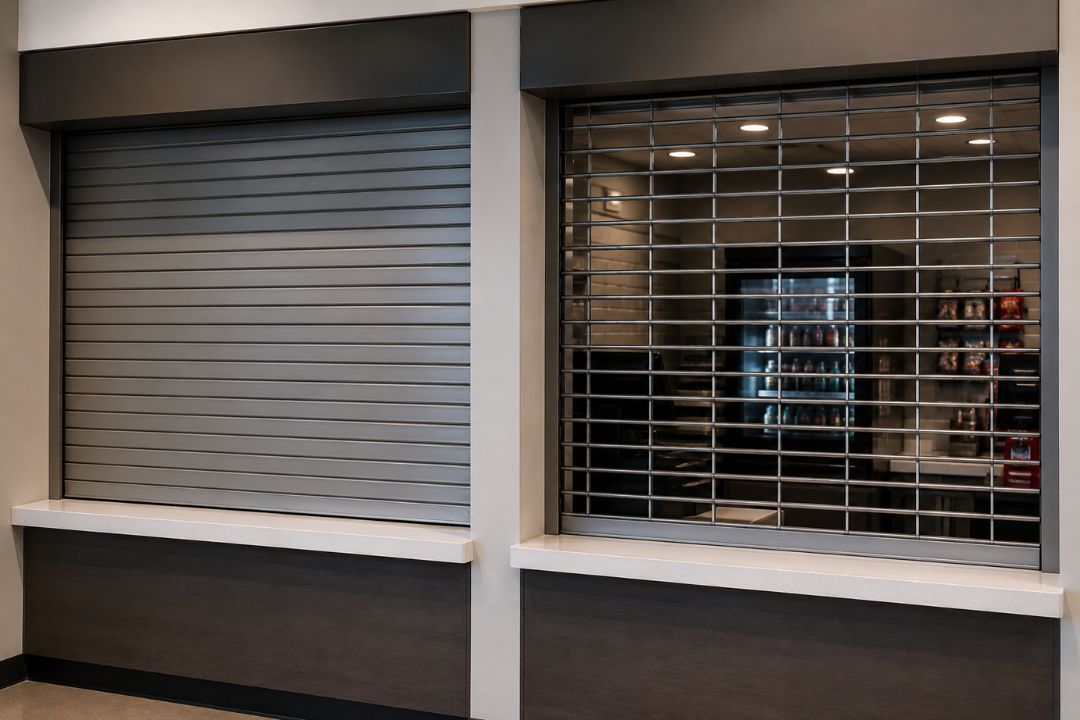
Solid slats give you maximum security and privacy. Nobody sees in, nothing gets through, and the space reads as clearly closed. This is the right pick for pharmacies, cash-handling counters, and anywhere with valuable inventory behind the shutter.
Grilles use spaced rods rather than solid slats, so they allow visibility and airflow while still securing the opening. They're ideal for storefronts where you want passersby to see merchandise after hours, or for spaces that need ventilation.
There's also a middle ground: perforated slats, which offer partial visibility with more security than an open grille. If you're weighing this alongside a larger project, the same logic applies to a full
commercial garage door installation, where visibility and security trade off in exactly the same way.
How It Opens: Three Options
Operation is your second decision, and it's driven mostly by how often the shutter cycles and how big it is.
Push-up is the simplest and cheapest. You lift it by hand. It works fine for smaller, lighter shutters that open once in the morning and close once at night.
Hand-crank gives you a smoother manual experience for larger or heavier shutters. It's still manual, but far less strain on your staff.
Motorized is push-button operation, often with a compact tubular motor concealed in the header. If your shutter cycles many times a day, or the opening is large, this is the one to choose. It eliminates physical strain, keeps operation consistent, and can integrate with your security or fire system.
The rule of thumb: a busy cafeteria or airport kiosk wants a motor. A small concession stand that opens and closes once a day does not.
Materials, Finishes, and Looks
Counter shutters come in galvanized steel, stainless steel, and aluminum, with wood options available for interiors where appearance matters most.
Finishes go well beyond plain metal. Powder coating comes in well over a hundred colors, so the shutter can match your brand or disappear into the wall. Some businesses add vinyl graphics to the curtain and hood, turning the closed shutter into signage, a school logo, or sponsorship space at a stadium.
Countertops are also available as part of a complete closure package, which gives you a finished, integrated look rather than a shutter bolted onto an afterthought.
Do You Need a Fire-Rated Shutter?
This one isn't a preference. It's code.
If your counter opening sits in a fire barrier or smoke wall, local building and fire codes will likely require a fire-rated counter shutter. These close automatically when triggered, compartmentalizing the space to contain smoke and flame and buy people time to evacuate.
Fire ratings typically come in 3/4-hour, 1.5-hour, and 3-hour options, and smoke-seal packages are available where draft control is required. A standard counter shutter, by contrast, is built for daily use and security, not flame resistance.
Your installer should know which applies to your building before anything is ordered. Getting this wrong means failing inspection.
Sizing and Installation
Standard counter shutters cover openings up to roughly 21 feet wide and 10 feet high, with a total area limit around 180 square feet. Wind-load-rated units run smaller, closer to 14 by 10 feet.
Installation is usually quick, especially with slip-in integral frame units built to your exact opening. Even so, precise measurement matters. The shutter has to fit the opening, the header has to accommodate the coil, and the guides need solid mounting.
That's why counter shutter installation is worth handing to a commercial door team rather than a general contractor. It's the same skill set behind our commercial garage door services, just at a smaller, more finished scale.
Secure Your Counter the Right Way
A counter shutter is a small piece of hardware that does a big job. It protects your inventory overnight, keeps your space clean and code-compliant, and does it without dominating the room you've built.
We've been fitting commercial doors and shutters across the Arkansas River Valley and Eastern Oklahoma since 1985, and we'll help you spec the right curtain, operation, and rating for your space.
Businesses needing garage door services in Russellville, AR and across the region can call Fort Smith Garage Door Co. at (479) 646-4644 to request a quote.
Frequently Asked Questions
What's the difference between a counter shutter and a security grille?
A counter shutter uses solid interlocking slats, so it fully blocks the opening for maximum security and privacy. A grille uses spaced rods, which allow visibility and airflow while still securing the space. Choose slats when you need to hide and protect, and grilles when you want people to see in.
How much headroom does a counter shutter need?
Very little. Because counter shutters use compact slats and smaller hardware than full-size rolling doors, some integral-frame models need as little as 8 inches above the opening. That's what makes them practical in finished retail interiors where space is tight.
Should I get a manual or motorized counter shutter?
It depends on how often it cycles. If the shutter opens once at the start of the day and closes at the end, push-up or hand-crank is perfectly fine and costs less. If it opens and closes repeatedly throughout the day, or the opening is large, a motor saves your staff real physical strain.
Do I need a fire-rated counter shutter?
Only if your opening is in a fire barrier or smoke wall, in which case local code will require it. Fire-rated shutters close automatically to contain smoke and flame, and they come in 3/4-hour, 1.5-hour, and 3-hour ratings. A commercial installer can tell you what your building needs.
How long do counter shutters last?
Built for daily commercial use, a quality counter shutter lasts many years with basic maintenance. Motorized units benefit from periodic checks of the motor and safety edge, while manual shutters mostly need clean guides and occasional lubrication.
Can a counter shutter match my store's design?
Yes, easily. Powder coat finishes come in well over a hundred colors, and materials range from galvanized and stainless steel to aluminum and even wood. You can also add vinyl graphics or a custom countertop for an integrated, finished look.